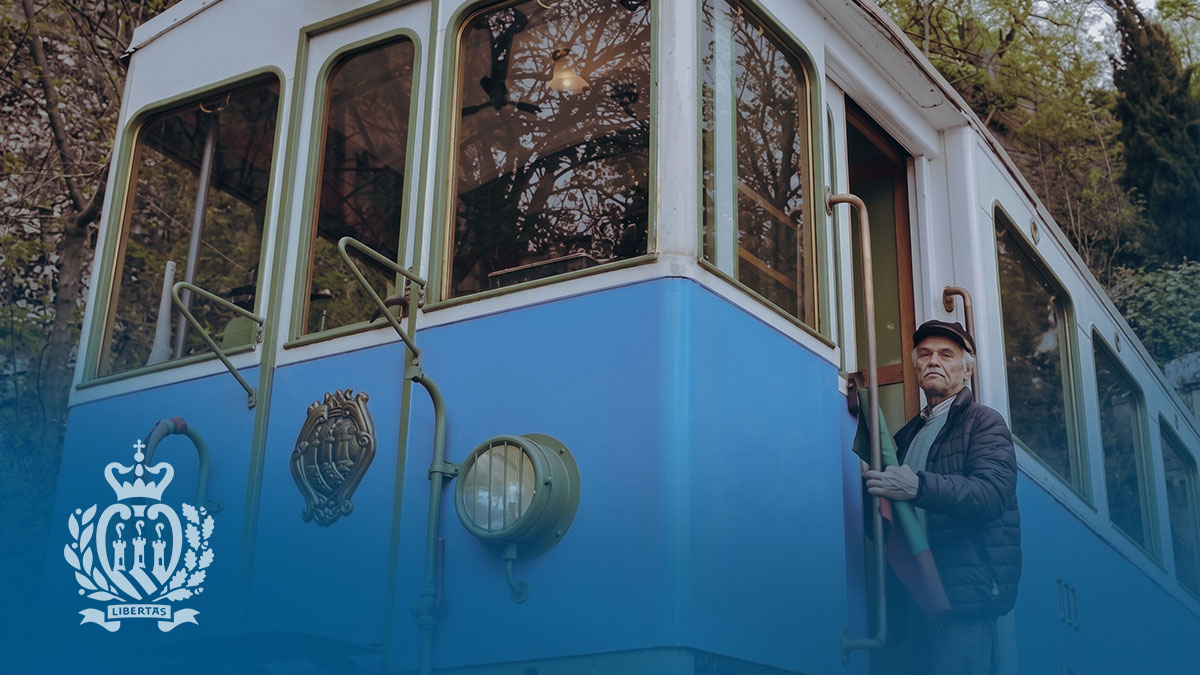
There are railways that carry passengers, and there are railways that carry memory. The Treno Bianco Azzurro — San Marino’s White and Blue Train — belongs unmistakably to the second category. Its return to service is far more than the reopening of a historic line: it is the revival of one of Europe’s most extraordinary stories of engineering ambition, wartime resilience, and human compassion.
The early results already tell their own story. As ATBA Vice-President Giancarlo “Yuma” Terenzi observed, “the numbers are already proving us right.” Hundreds of visitors have climbed aboard in these first weeks, not merely to enjoy the novelty of a restored railway, but to step physically into a chapter of history that shaped the identity of the world’s oldest republic.
An Engineering Masterpiece on Mount Titano
When the electric railway linking Rimini to the City of San Marino was inaugurated in 1932, it was hailed as a triumph of engineering. In just thirty-two kilometres, the line climbed from the Adriatic coast to more than 600 metres above sea level, threading its way through tunnels and across viaducts carved into the flank of Mount Titano. For a mountain republic of a few thousand inhabitants, determined to connect itself with the wider world, it was a statement of ingenuity and of will: proof that geography need not be destiny.
Yet the railway’s greatest legacy was not written in peacetime.
When Tunnels Became Sanctuaries
In the summer of 1944, as the front line of the Second World War tore through central Italy, bombing devastated the railway and brought its service to an end. But the line was not finished; its purpose was transformed. The very tunnels that had been bored through rock to carry trains became places of refuge.
As violence engulfed the surrounding region, an estimated 100,000 civilians found shelter within San Marino’s borders, many of them inside the railway galleries themselves. Families lived for weeks beneath the mountain, protected by solid rock from the air raids, the fighting, and the persecution raging outside. In one of the darkest hours of European history, a transport system became a sanctuary.
Consider the scale of that act. A neutral republic of barely 15,000 souls opened its gates and its tunnels to many refugees, several times its own population. It asked no questions of creed, politics, or origin. It remains one of the proudest moments in Sammarinese history, and a living testament to the Republic’s ancient tradition of liberty, neutrality, and respect for human dignity, a tradition that has endured, unbroken, for more than seventeen centuries.
Why This Railway Matters Today
Every journey aboard the White and Blue Train now carries that memory forward. Passengers do not simply travel along lovingly restored tracks; they pass through galleries that once saved lives. Each tunnel tells a double story of remarkable engineering and of the courage, generosity, and hope that flourished within it when history demanded.
Across Europe, many heritage railways rightly celebrate industrial achievement. The San Marino railway celebrates something greater still: the capacity of infrastructure to become an instrument of humanity. It teaches a lesson that engineers, policymakers, and citizens alike would do well to remember: that what we build is ultimately measured not by its steel and stone, but by what it makes possible for people.
The White and Blue Train is therefore not merely a tourist attraction. It is a moving museum, a classroom without walls, and a rolling monument to the thousands who found safety beneath Mount Titano.
Sometimes a railway connects cities.
Sometimes it connects generations.
And sometimes — as San Marino’s White and Blue Train so beautifully reminds us — it connects us with the very best of humanity.

